← Back to home
AIProduct ManagementCompliance
O.R.A.C.L.E
A Product Ownership Framework for AI-Native AML
Sai Teja Bharadwaj
July 17, 2026 · 9 min read
There is an open secret in the global financial system. Every year, between $800 billion and $2 trillion in illicit funds move through institutional channels, and authorities intercept less than 1 percent of it.
To combat this, the financial services industry has spent the last decade dramatically expanding compliance functions. Regulators have levied $36 billion in fines. To put that $800 billion to $2 trillion figure in perspective, that is roughly the GDP of a country moving through the financial system undetected every year, according to UNODC estimates. The $36 billion in fines is real too. Banks have expanded their first and second lines of defense, elevated Chief Risk Officers, and poured hundreds of millions into regulatory technology.
Yet, if you ask an AML practitioner what they actually do all day, you might get a frustratingly honest answer. They tick boxes. The current system is incredibly expensive, highly manual, and optimized almost entirely for procedural compliance rather than actually stopping financial crime.
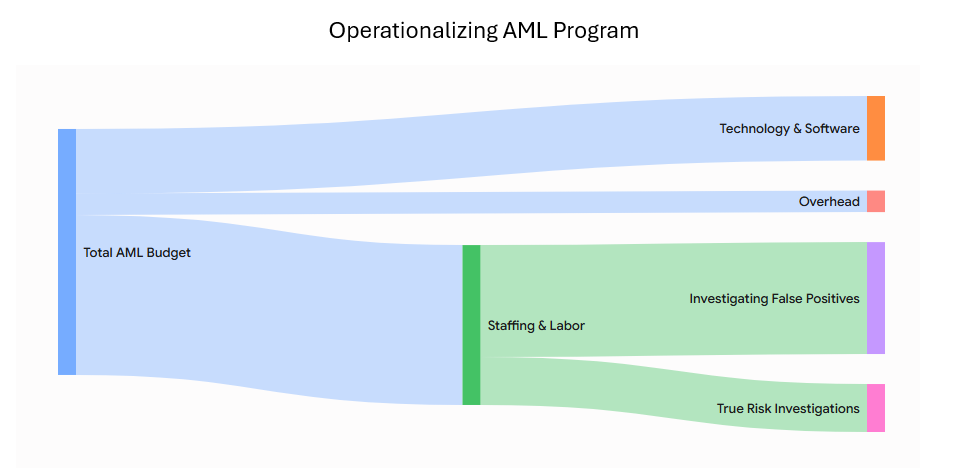
Look at where the money actually goes. Staffing and labor, not technology, is the single biggest line item in the typical AML budget, and most of that staffing spend flows into investigating false positives. True risk investigations, the actual point of the entire program, get whatever is left over. Institutions are not underspending on compliance. They are spending an enormous amount of money very precisely on the wrong problem.
For Product Owners tasked with implementing AI in this environment, the challenge is enormous. You cannot simply bolt generative AI onto a broken process. You need a structured methodology to navigate the intersection of technical innovation and strict regulatory boundaries.
The O.R.A.C.L.E Framework
The Problem Is Not a 98 Percent Failure Rate
If a retail banking team deployed a credit risk model that was inaccurate 98 percent of the time, that model would be decommissioned immediately. In the world of transaction monitoring, however, that failure rate is standard operating procedure.
Legacy systems generate millions of alerts, but only one or two out of every hundred are typically acted upon. The rest are false positives.
As a result, banks employ armies of highly trained investigators who spend up to 85 percent of their time on purely administrative tasks. They manually collect data across disjointed systems just to click "Close: Not Suspicious" on transactions that never posed a real threat. Furthermore, to satisfy auditors and avoid massive penalties, institutions file thousands of defensive Suspicious Activity Reports (SARs).
When tasked with finding a needle in a haystack, legacy compliance systems essentially recommend setting the entire farm on fire.
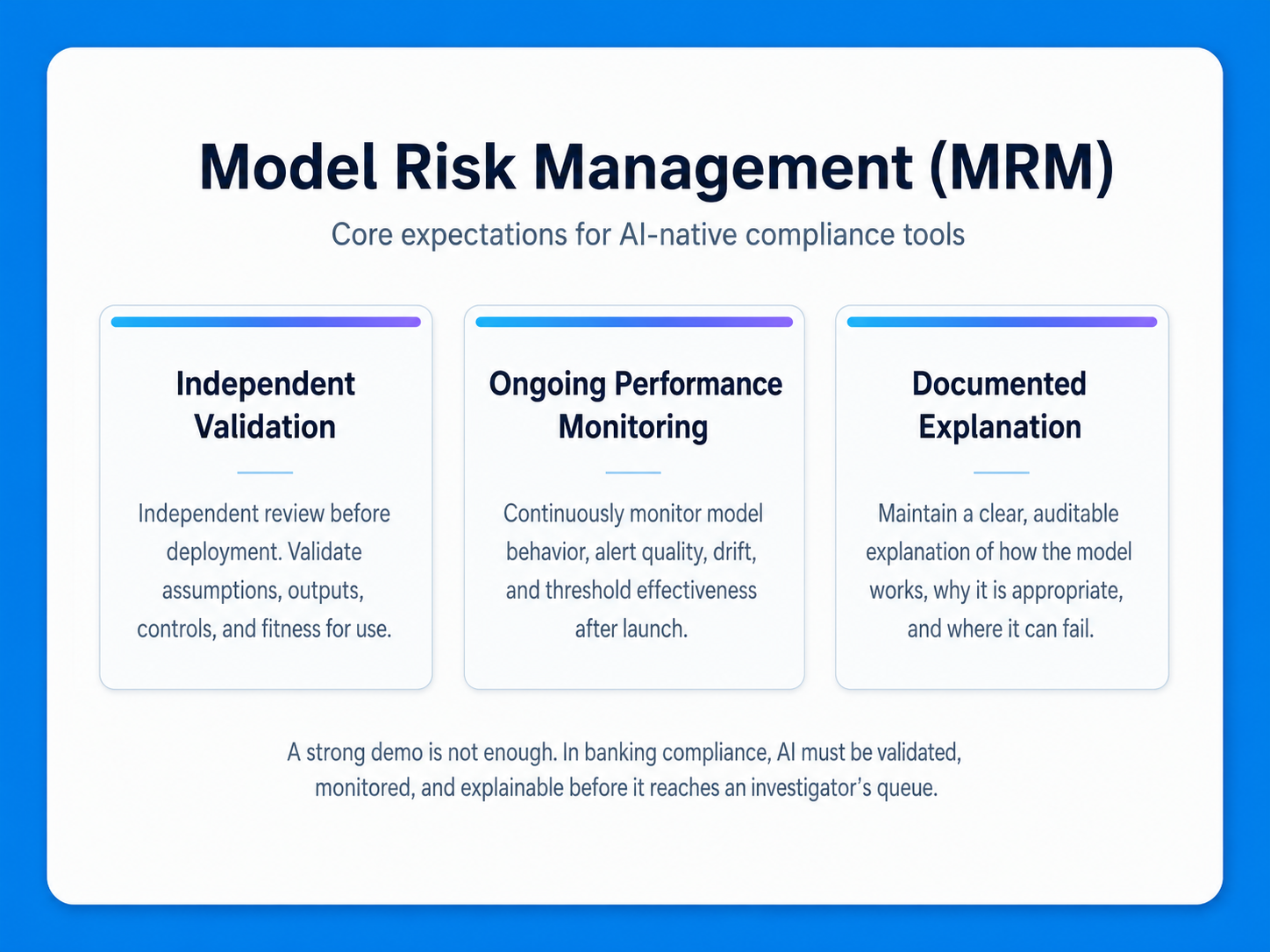
Here is the part that most AI-in-AML pitches conveniently skip. Any AI system that influences a disposition decision, be it closing an alert, escalating a case, or drafting a SAR, is not just a feature. Under the expectations of Model Risk Management (MRM) across banking systems, it is still a model. And models do not just ship casually because the demo looked great.
Independent validation, ongoing performance monitoring, and a documented explanation of why the thing works need to happen before it ever touches an investigator's queue.
Skip this step and you haven't built an AI-native compliance tool. You've built an unvalidated model wearing a compliance costume.
This is not a reason to avoid AI in AML. It is a reason to build the governance scaffolding at the same time as the product, not as an afterthought.
Product Owners in the financial crimes space face a unique dilemma. Traditional Agile frameworks prioritize speed and minimal documentation, which directly conflicts with regulatory demands for predictable timelines, absolute accuracy, and heavy audit trails.
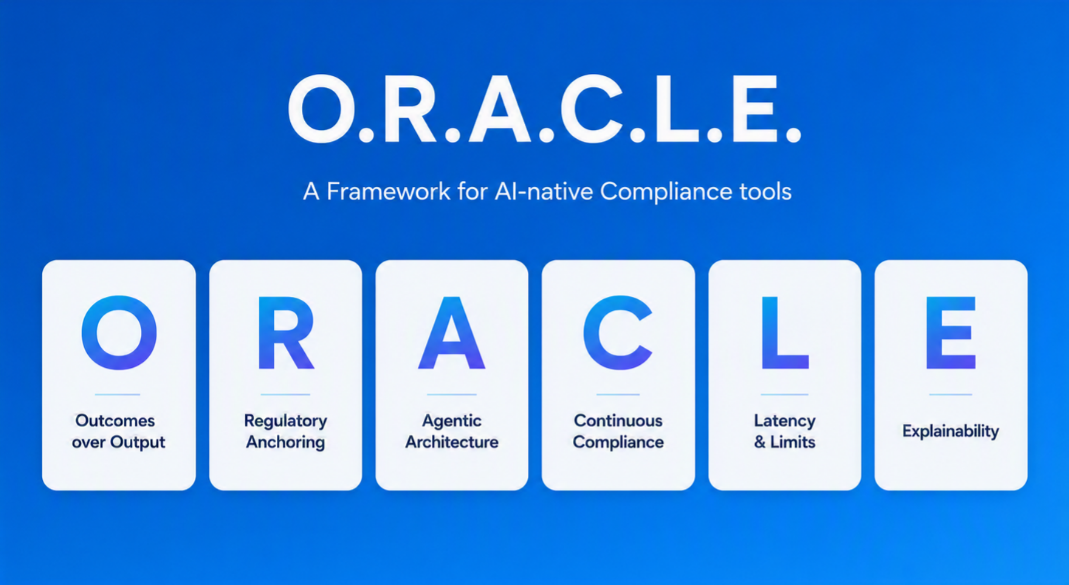
O.R.A.C.L.E. is a product management playbook designed specifically for AI-native compliance tools. It shifts the development focus away from optimizing the status quo and toward building tools that actually serve the investigator.
- Outcomes over Output: The industry must stop measuring the sheer volume of alerts processed. Success is no longer defined by how much noise the system generates, but by how effectively it identifies true risk. Product roadmaps must prioritize features that yield high-quality, actionable leads.
- Regulatory Anchoring: Every feature in the backlog must be tied directly to a specific regulatory mandate. Vague tickets produce vague audits, and nobody wants to be the product owner explaining to an examiner why a backlog item is just labeled as "AML stuff." When engineering teams understand exactly how a data pipeline mitigates Customer or Geographic risk, it eliminates friction and ensures the product remains compliant by design.
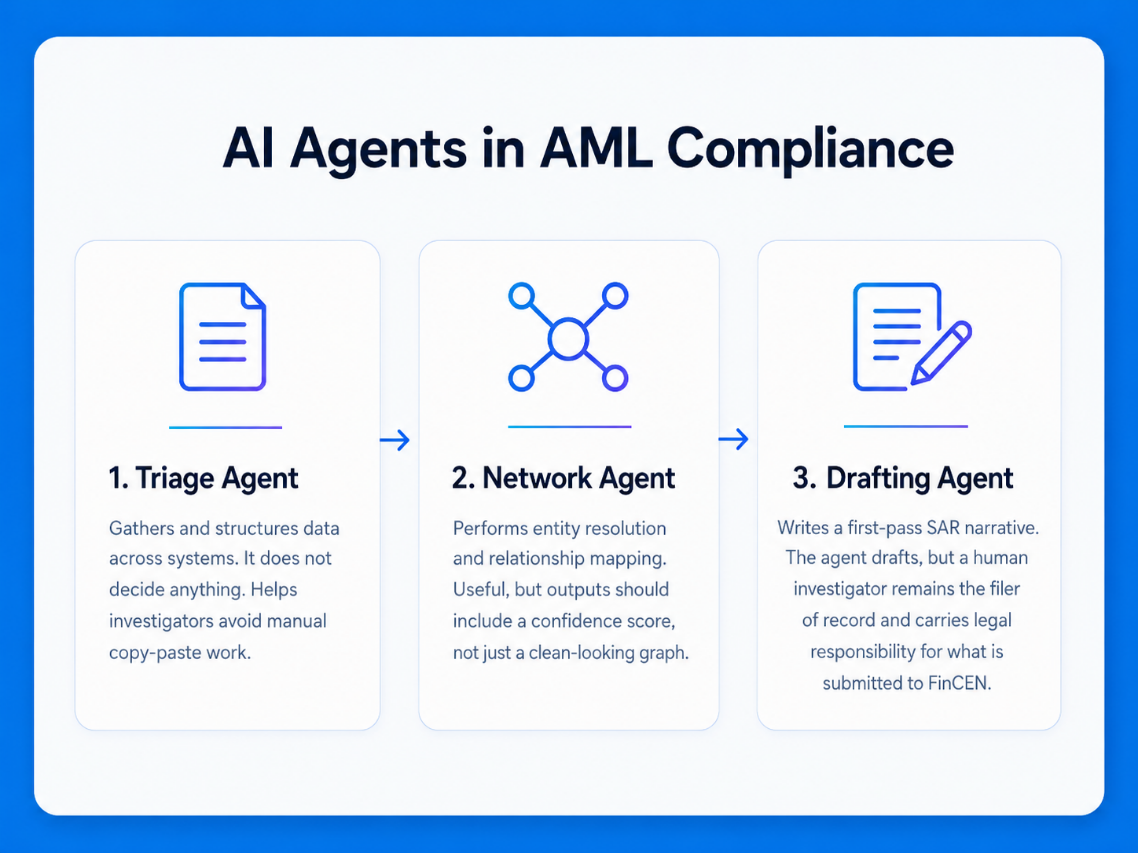
- Agentic Architecture: Saying "deploying a network of specialized agents" is the easy part. Every vendor deck has a slide with the same Triage, Network, and Drafting agents connected by arrows. The hard part is answering the question: when the agent is wrong, who is holding the bag?
A well-structured approach has escalation logic too. High-risk typologies (sanctions nexus, PEP involvement, structuring patterns) should always route to a human, regardless of how confident the agent claims to be. Confidence is not the same as correctness, and an agent that is "pretty sure" about a sanctions hit is exactly the kind of thing you want a human to double check before anyone files anything.
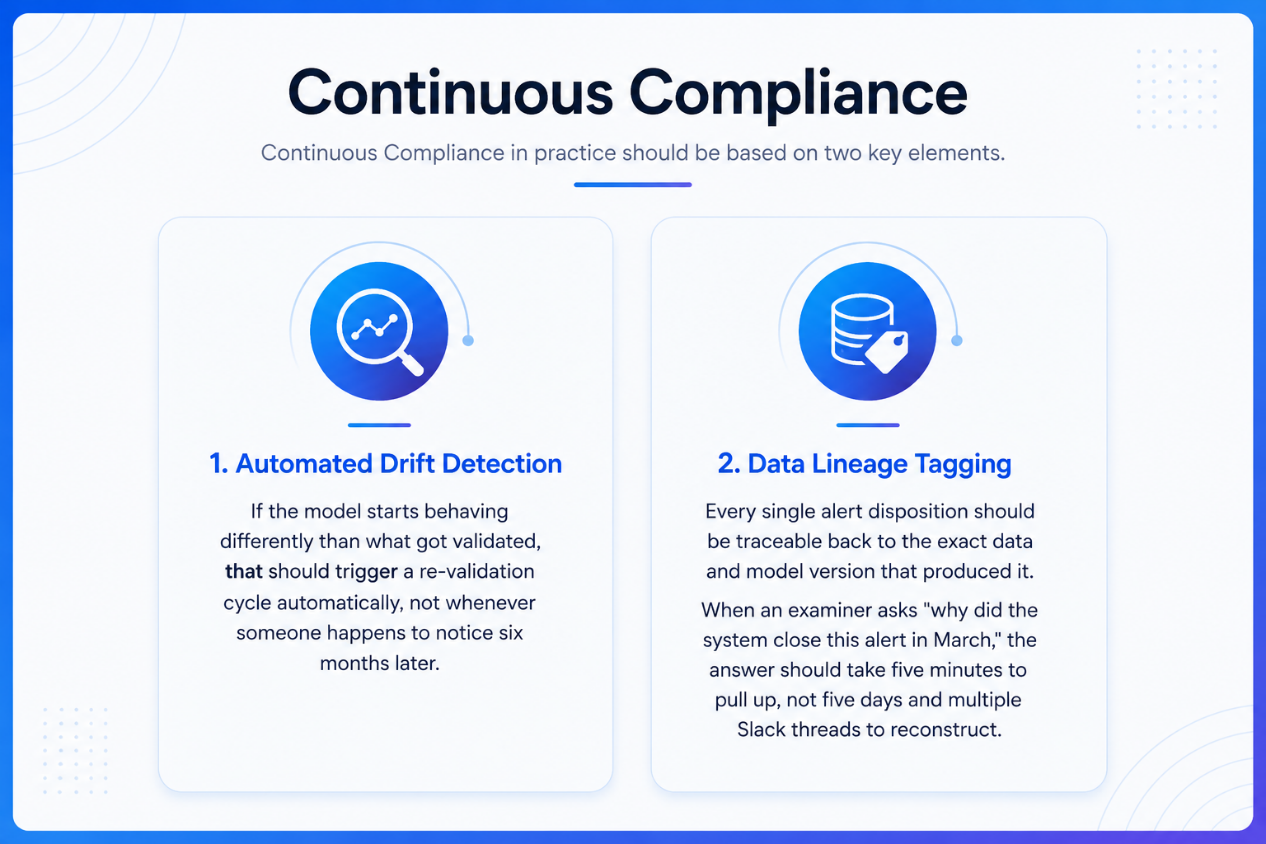
- Continuous Compliance: Compliance cannot be a manual bottleneck tacked onto the end of a release cycle. In practice, it comes down to two things: automated drift detection and data lineage tagging, both built directly into the pipeline rather than checked after the fact.
- Latency & Limits: Manage risk with "Error Budgets." If regulators mandate that all SARs must be filed within 30 days of discovery, set your internal engineering deadline to 15 days. That 15-day window is your budget. If data ingestion delays or software bugs consume that time, all new feature development stops. The entire team shifts to fixing the pipeline, providing you with an emotionless, absolute trigger to pause feature work and prioritize system health.
- Explainability: In financial crimes, an accurate prediction is useless if it cannot be explained to a regulator. Every automated decision must generate a clear, human-auditable logic path. Worth being specific about which kind of explainability you mean, because AML folks will quietly assume you mean one or the other. There is model-level explainability (feature attribution: why did the risk score fire, which validators and examiners care about), and there is narrative-level explainability (a plain-English rationale an investigator can read and defend, which is what actually goes in front of a regulator during an exam). Good AI-native tools need both. One without the other is like having a black box with a very polite note taped to it saying "trust me."
The true value of O.R.A.C.L.E. lies in its ability to flip the current operational model on its head.
Right now, automated alerts drive the workflow, resulting in an avalanche of false positives. But when investigators are allowed to follow high-quality leads, such as specific requests from law enforcement or targeted negative news, the success rate skyrockets. In FY 2024, the FBI reported that BSA-derived intelligence, SARs and CTRs, was linked to 32 percent of active investigations in its Complex Financial Crime Program, and to 40 percent of cases in its Organized Crime Drug Enforcement Program. That is what a signal looks like when it is actually chased down by someone with an investigative reason to look, rather than generated by an alert threshold and handed to whoever is next in the queue.
By using Agentic Architecture to automate 85 percent of the work that is purely administrative, banks can deploy their human capital where it matters. Investigators are freed to be proactive. They can connect the dots across financial transactions, trade invoices, and predicate crimes.
Before getting to KPIs, one honest caveat. None of these metrics mean anything if the model underneath them has not been validated and the agents producing the leads are not auditable. A False Positive Reduction Rate looks fantastic right up until an examiner asks how you validated the model that produced it, and "the dashboard looked good" is not an acceptable answer. Governance is not the boring prerequisite to good KPIs. It is the reason the KPIs are trustworthy at all.
Rethinking KPIs for AI-Native AML
To truly execute the "O" (Outcomes over Output) in the O.R.A.C.L.E. framework, leadership must abandon legacy dashboards. Tracking metrics like "Total Alerts Generated" or "SARs Filed" only proves that a system is generating noise.
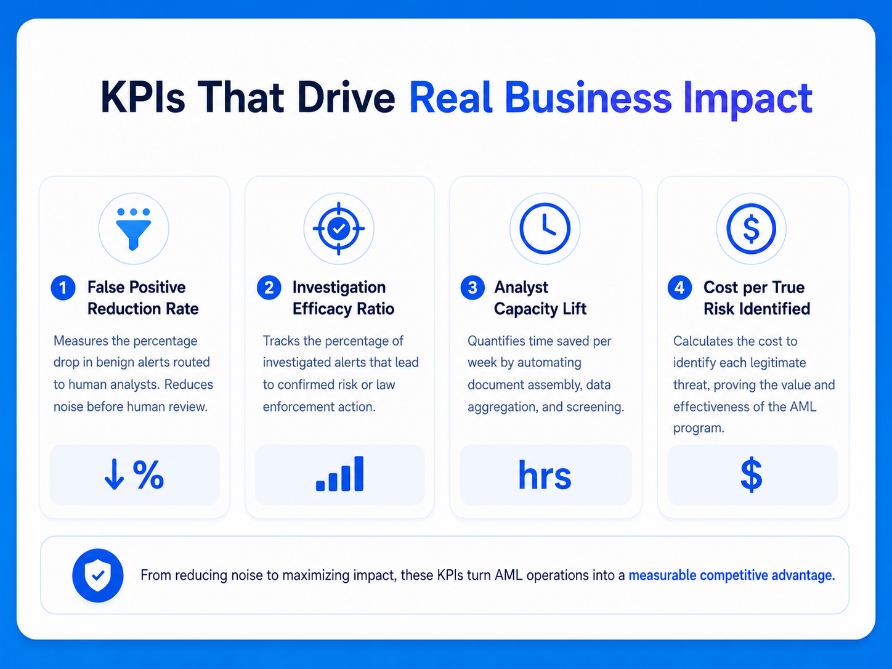
To measure actual business impact and operational efficiency, product teams should transition to the following KPIs:
- False Positive Reduction Rate: This measures the percentage drop in benign alerts routed to human analysts. A successful AI implementation should drastically shrink the top of the funnel before human intervention is required.
- Investigation Efficacy Ratio: This tracks the percentage of investigated alerts that lead to a confirmed risk or law enforcement action. It is the ultimate indicator of signal-to-noise ratio health.
- Analyst Capacity Lift: Measured in hours, this metric quantifies the time saved per week by automating document assembly, data aggregation, and negative news screening. It demonstrates how the product is unlocking human capital.
- Cost per True Risk Identified: By dividing the total operational cost of the AML program by the number of legitimate threats intercepted, institutions can finally put a dollar value on their effectiveness, shifting the narrative from cost center to active risk mitigation.
- Model Validation Cycle Time: This measures how quickly the institution can re-certify a model after a material change or a drift signal. A fast, well-documented re-validation cycle is a sign of a healthy governance pipeline. A slow one is usually the thing regulators zero in on first, well before they get to whether your false positive rate looks nice on a slide.
The Path Forward
The era of procedural, box-ticking compliance is reaching its breaking point. Regulators and board members alike are losing patience with incredibly expensive infrastructures that fail to intercept the vast majority of illicit funds.
It is time to re-align the product roadmap. Implement strict error budgets to protect your engineering teams. Build modular, agentic workflows to handle the administrative burden. Most importantly, build technology that puts the investigator back at the center of the process.
None of this replaces regulatory judgment, and it should not try to. The goal is not to remove human accountability from the process. It is to stop wasting that accountability on data entry, so investigators can spend it on the things a machine still cannot judge, call, contextualize, and know when something goes off track.
This framework is a work in progress, not a finished system, and it gets better with more people contributing to it. If you're a product owner, compliance leader, or just someone who has opinions about better product management practices, I'd like to hear where you agree, where you don't, and what I'm missing. Let's connect. And if this kind of thinking is useful to you, there's more of it on my portfolio.